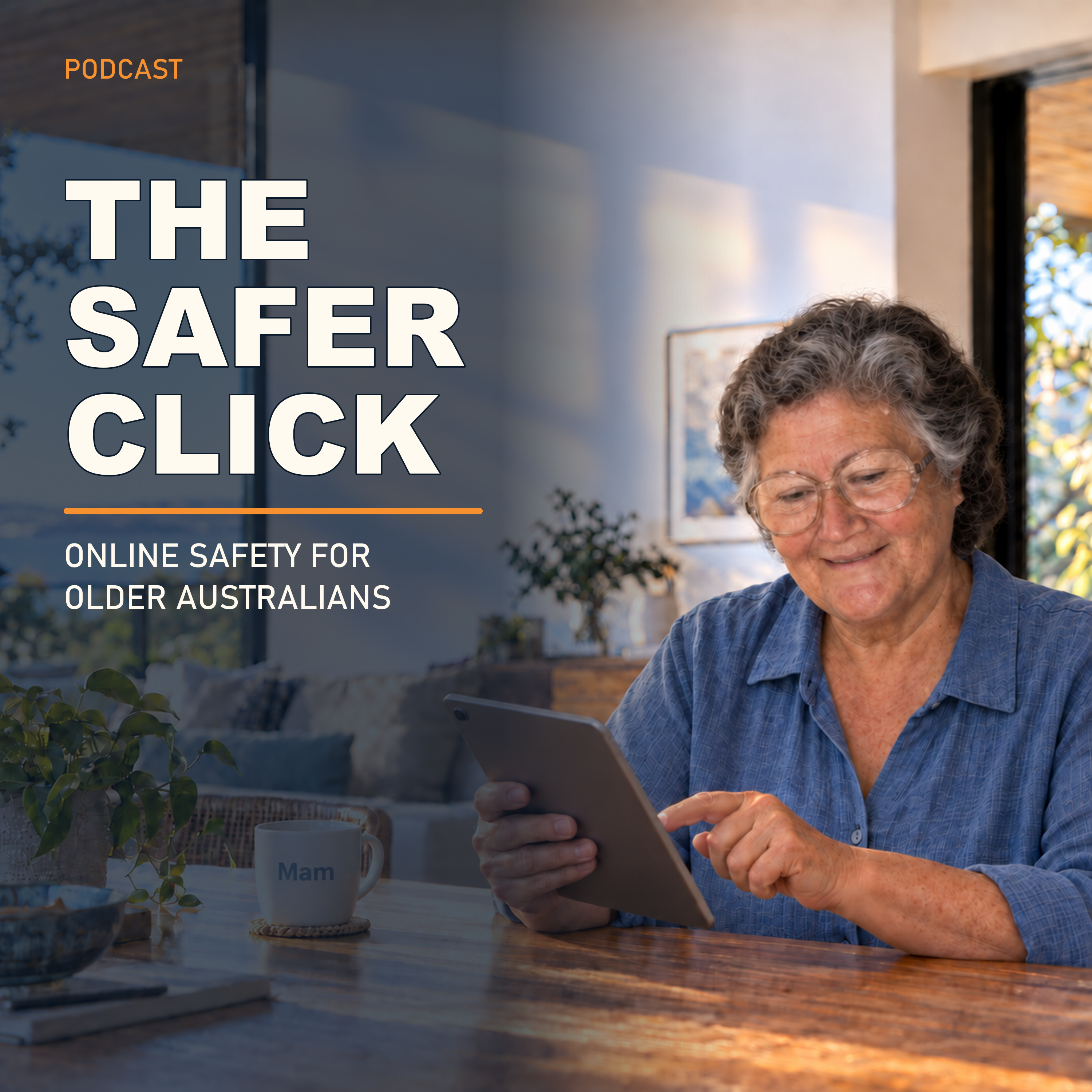
Clear, practical lessons for staying safer online.
Graham True and Clara Connor help older listeners recognise online risks and build safer habits in calm, straightforward language.
Advice is based on publicly available guidance from sources including the Australian Cyber Security Centre and Scamwatch. The Safer Click is independent and is not produced by, affiliated with or endorsed by any government organisation.
AustralianPlain EnglishHosted by Graham & Clara
Latest episodes
Listen now
Episode 18 · 6 minutes
A Pop-Up Says Your Computer Is Infected
A full-screen browser warning claims your computer is infected and tells you to call immediately. Graham and Clara explain how to close the warning safely without calling the number.
Today’s safer habit: A full-screen virus warning that tells you to call is a reason to close the browser, not to phone the number on the screen.
Episode 17 · 6 minutes
The Lottery You Didn't Enter
A letter, email or text says you have won a lottery or prize you did not enter, then asks for a fee, tax or identity details to collect it. Clara and Graham explain why unexpected winnings are not proof of a real prize and set one practical action: send nothing and walk away.
Today’s safer habit: Unexpected winnings are not proof of a real prize, and a genuine lottery does not ask you to pay a fee to collect it.
Episode 16 · 7 minutes
They Can't Meet, But They Need Money
Someone met online has built a warm relationship but cannot meet or video call, then asks for money to solve an urgent problem. Clara and Graham explain why an online relationship is not proof of identity and set one practical action: send nothing and tell someone you trust.
Today’s safer habit: A warm online relationship, even one lasting months, is not proof that the person is who they claim to be.
Episode 15 · 7 minutes
The Investment Tip Everyone Is Sharing
A social media group is excited about an investment promising high returns with little risk. Clara and Graham explain why popularity is not proof and set one practical action: do not transfer money until you have independently checked the business, the person and the licence.
Today’s safer habit: Excitement, familiar names and apparent profits do not prove that an investment or the person promoting it is genuine.
Episode 14 · 6 minutes
Your Parcel Couldn't Be Delivered
A delivery text says a parcel is waiting and asks for a small redelivery fee. Clara and Graham explain why the timing can feel convincing and set one practical action: check the order through the retailer or courier's official app instead of the message link.
Today’s safer habit: A parcel message can arrive at a believable moment, but the message itself is not proof that your delivery has a problem.
Episode 13 · 7 minutes
The Copy That Saves the Day
A computer stops working and years of family photos may be trapped on it. Clara and Graham explain what a backup is, then set one practical job: back up one important device and restore a file to check it works.
Today’s safer habit: A backup is a copy you can use when important files are lost, but it only earns your trust after you have restored a file from it.
Episode 12 · 6 minutes
Free Wi-Fi Without the Worry
You are away from home and need to check your bank account, but the only nearby connection is public Wi-Fi. Clara and Graham explain why mobile data is the better choice for sensitive accounts.
Today’s safer habit: Public Wi-Fi cannot always be trusted, so save sensitive tasks for a trusted home, office or mobile connection.
Episode 11 · 6 minutes
The Update You've Been Putting Off
A phone or tablet keeps asking to install an update. Clara and Graham explain what updates fix and walk through one practical action: install the pending update from the device's own settings.
Today’s safer habit: Software updates close known security weaknesses, so repeated update prompts should not be put off indefinitely.
Episode 10 · 5 minutes
Has Your Friend Been Cloned?
A duplicate social-media profile sends a friend request. Graham and Clara explain why you should contact the real friend through an existing known channel before accepting.
Today’s safer habit: A second profile that looks like someone you already know is not proof it is them; check through a channel you already use.
Episode 9 · 6 minutes
The Marketplace Buyer in a Hurry
A marketplace buyer sends a payment, verification, or courier link and asks you to leave the platform. Graham and Clara explain why messages and payments should stay inside the marketplace.
Today’s safer habit: A hurried buyer who moves you off the marketplace with a payment or courier link is asking you to give up the platform's protection.
Episode 8 · 6 minutes
Before You Scan That Code
A QR code appears on a parking meter or an unsolicited letter. This kind of QR-code phishing is called quishing. Graham and Clara explain how to check the destination shown by the phone before opening it and to prefer an official app where one is available.
Today’s safer habit: A QR code is not a safe shortcut until you have checked the destination the phone shows and preferred an official app where one exists.
Episode 7 · 6 minutes
A Message From myGov?
A text says there is a myGov refund or account problem and provides a sign-in link. Graham and Clara explain how to leave the message alone and check myGov independently.
Today’s safer habit: A message that looks like myGov is not a safe place to sign in; open myGov independently and check the account there.
Episode 6 · 6 minutes
Don't Hand Over the Mouse
An unexpected caller says your computer needs urgent repairs and asks for remote access. Graham and Clara explain why the safest response is to hang up and contact the company yourself.
Today’s safer habit: Hang up, then contact the company through its official website or secure app if you need to check the caller's story.
Episode 5 · 5 minutes
The Extra Lock on Your Account
A stolen password can open an email account in seconds. Graham and Clara explain how multi-factor authentication adds a second barrier that a stolen password alone cannot clear.
Today’s safer habit: A stolen password alone is not enough to break into an account if a second verification step is also required.
Episode 4 · 7 minutes
Hi Mum, I've Lost My Phone
A message from a new number sounds like a family member in trouble. Graham and Clara explain how to step outside the conversation and check who is really asking for help.
Today’s safer habit: A familiar story and an urgent request do not prove that a message came from your family member.
Episode 3 · 6 minutes
Is That Really Your Bank Calling?
An unexpected caller says there is fraud on your bank account and offers to fix it. Graham and Clara explain why the safest response is to end the call and contact the bank yourself.
Today’s safer habit: A familiar caller name, convincing details and urgent language do not prove that a caller works for your bank.
Episode 2 · 5 minutes
One Password Is Not Enough
The same password protects email, shopping and social accounts. Graham and Clara explain how password reuse turns one data breach into an open door to everything.
Today’s safer habit: Reusing a password across accounts turns one data breach into a master key for everything connected to that password.
Episode 1 · 6 minutes
Stop Before You Tap
A realistic road-toll text arrives at breakfast. Graham and Clara show how one small change of route can keep a rushed tap from becoming a costly mistake.
Today’s safer habit: A message can look convincing and still be false; urgency is your cue to slow down and verify it somewhere else.